South East Asia ( SEA )

Southeast Asia or Southeastern Asia is a subregion of Asia, consisting of the countries that are geographically south of China, east of India, west of New Guinea and north of Australia. The region lies near the intersection of geological plates, with heavy seismic and volcanic activity. Southeast Asia consists of two geographic regions:
Maritime Southeast Asia, comprising Indonesia, East Malaysia, Singapore, Philippines, East Timor, Brunei, and Christmas Island.
Mainland Southeast Asia, also known as Indochina, comprising Cambodia, Laos, Myanmar (Burma), Thailand, Vietnam, and West Malaysia;
Political
Definitions of "Southeast Asia" vary, but most definitions include the area represented by the countries (sovereign states and dependent territories) listed below. All of the states except for East Timor are members of the Association of Southeast Asian Nations (ASEAN). The area, together with part of South Asia, was widely known as the East Indies or simply the Indies until the 20th century. Christmas Island and the Cocos (Keeling) Islands are considered part of Southeast Asia though they are governed by Australia. Sovereignty issues exist over some territories in the South China Sea. Hong Kong, Macau, and Taiwan (a disputed region or nation), are considered as part of the Southeast Asia. Papua New Guinea has stated that it might join ASEAN, and is currently an observer.
Geographical
Southeast Asia is geographically divided into two subregions, namely Mainland Southeast Asia (or Indochina) and Maritime Southeast Asia (or the similarly defined Malay Archipelago) (Malay: Nusantara).
Mainland Southeast Asia includes:
Cambodia
Laos
Myanmar (Burma)
Thailand
Vietnam
Peninsular Malaysia
Maritime Southeast Asia includes:
Indonesia
Philippines
East Malaysia
Brunei
Singapore
East Timor
The Andaman and Nicobar Islands of India are geographically considered part of Southeast Asia. Eastern Bangladesh and the Seven Sister States of India are culturally part of Southeast Asia and sometimes considered both South Asian and Southeast Asian. The Seven Sister States of India are also geographically part of Southeast Asia. The rest of the island of New Guinea which is not part of Indonesia, namely, Papua New Guinea, is sometimes included so are Palau, Guam, and the Northern Mariana Islands, which were all part of the Spanish East Indies.
The eastern half of Indonesia and East Timor (east of the Wallace Line) are considered to be biogeographically part of Oceania.
History
Homo sapiens reached the region by around 45,000 years ago, having moved eastwards from the Indian subcontinent. Homo floresiensis also lived in the area up until 12,000 years ago, when they became extinct. Austronesian people, who form the majority of the modern population in Indonesia, Malaysia, Brunei, East Timor, and the Philippines, may have migrated to Southeast Asia from Taiwan. They arrived in Indonesia around 2000 BC,and as they spread through the archipelago, they often settled along coastal areas and confined indigenous peoples such as Negritos of the Philippines or Papuans of New Guinea to inland regions.
Studies presented by HUGO (Human Genome Organisation) through genetic studies of the various peoples of Asia, empirically points out that instead of the other way around, another migration from the south first entered Southeast Asia and then travelled slowly northwards.
Solheim and others have shown evidence for a Nusantao (Nusantara) maritime trading network ranging from Vietnam to the rest of the archipelago as early as 5000 BC to 1 AD. The peoples of Southeast Asia, especially those of Austronesian descent, have been seafarers for thousands of years, some reaching the island of Madagascar. Their vessels, such as the vinta, were ocean-worthy. Magellan's voyage records how much more manoeuvrable their vessels were, as compared to the European ships.
Passage through the Indian Ocean aided the colonisation of Madagascar by the Austronesian people, as well as commerce between West Asia and Southeast Asia. Gold from Sumatra is thought to have reached as far west as Rome, while a slave from the Sulu Sea was believed to have been used in Magellan's voyage as a translator.
Originally most people were animist. This was later replaced by Hinduism. Theravada Buddhism soon followed in 525. In the 15th century, Islamic influences began to enter. This forced the last Hindu court in Indonesia to retreat to Bali.
In Mainland Southeast Asia, Burma, Cambodia and Thailand retained the Theravada form of Buddhism, brought to them from Sri Lanka. This type of Buddhism was fused with the Hindu-influenced Khmer culture.
Indianised Kingdoms
Very little is known about Southeast Asian religious beliefs and practices before the advent of Indian merchants and religious influences from the 2nd century BCE onwards. Prior to the 13th century CE, Hinduism and Buddhism were the main religions in Southeast Asia.

The Jawa Dwipa Hindu kingdom in Java and Sumatra existed around 200 BCE. The history of the Malay-speaking world began with the advent of Indian influence, which dates back to at least the 3rd century BCE. Indian traders came to the archipelago both for its abundant forest and maritime products and to trade with merchants from China, who also discovered the Malay world at an early date. Both Hinduism and Buddhism were well established in the Malay Peninsula by the beginning of the 1st century CE, and from there spread across the archipelago.
Cambodia was first influenced by Hinduism during the beginning of the Funan kingdom. Hinduism was one of the Khmer Empire's official religions. Cambodia is the home to one of the only two temples dedicated to Brahma in the world. Angkor Wat is also a famous Hindu temple of Cambodia.
The Champa civilisation was located in what is today central Vietnam, and was a highly Indianised Hindu Kingdom. The Vietnamese launched a massive conquest against the Cham people during the 1471 Vietnamese invasion of Champa, ransacking and burning Champa, slaughtering thousands of Cham people, and forcibly assimilating them into Vietnamese culture.
The Majapahit Empire was an Indianised kingdom based in eastern Java from 1293 to around 1500. Its greatest ruler was Hayam Wuruk, whose reign from 1350 to 1389 marked the empire's peak when it dominated other kingdoms in the southern Malay Peninsula, Borneo, Sumatra, and Bali. Various sources such as the Nagarakertagama also mention that its influence spanned over parts of Sulawesi, Maluku, and some areas of western New Guinea and the Philippines, making it the largest empire to ever exist in Southeast Asian history.
The Cholas excelled in maritime activity in both military and the mercantile fields. Their raids of Kedah and the Srivijaya, and their continued commercial contacts with the Chinese Empire, enabled them to influence the local cultures. Many of the surviving examples of the Hindu cultural influence found today throughout Southeast Asia are the result of the Chola expeditions.
Spread of Islam

In the 11th century, a turbulent period occurred in the history of Maritime Southeast Asia. The Indian Chola navy crossed the ocean and attacked the Srivijaya kingdom of Sangrama Vijayatungavarman in Kadaram (Kedah), the capital of the powerful maritime kingdom was sacked and the king was taken captive. Along with Kadaram, Pannai in present-day Sumatra and Malaiyur and the Malayan peninsula were attacked too. Soon after that, the king of Kedah Phra Ong Mahawangsa became the first ruler to abandon the traditional Hindu faith, and converted to Islam with the Sultanate of Kedah established in year 1136. Samudera Pasai converted to Islam in the year 1267, the King of Malacca Parameswara married the princess of Pasai, and the son became the first sultan of Malacca. Soon, Malacca became the center of Islamic study and maritime trade, and other rulers followed suit. Indonesian religious leader and Islamic scholar Hamka (1908–1981) wrote in 1961: "The development of Islam in Indonesia and Malaya is intimately related to a Chinese Muslim, Admiral Zheng He."
Children studying Qur'an in Java, Indonesia, during colonial period.
There are several theories to the Islamisation process in Southeast Asia. Another theory is trade. The expansion of trade among West Asia, India and Southeast Asia helped the spread of the religion as Muslim traders from Southern Yemen (Hadramout) brought Islam to the region with their large volume of trade. Many settled in Indonesia, Singapore, and Malaysia. This is evident in the Arab-Indonesian, Arab-Singaporean, and Arab-Malay populations who were at one time very prominent in each of their countries. The second theory is the role of missionaries or Sufis. The Sufi missionaries played a significant role in spreading the faith by introducing Islamic ideas to the region. Finally, the ruling classes embraced Islam and that further aided the permeation of the religion throughout the region. The ruler of the region's most important port, Malacca Sultanate, embraced Islam in the 15th century, heralding a period of accelerated conversion of Islam throughout the region as Islam provided a positive force among the ruling and trading classes.
Geography
Indonesia is the largest country in Southeast Asia and it also the largest archipelago in the world by size (according to the CIA World Factbook). Geologically, the Indonesian Archipelago is one of the most volcanically active regions in the world. Geological uplifts in the region have also produced some impressive mountains, culminating in Puncak Jaya in Papua, Indonesia at 5,030 metres (16,500 feet), on the island of New Guinea; it is the only place where ice glaciers can be found in Southeast Asia. The second tallest peak is Mount Kinabalu in Sabah, Malaysia on the island of Borneo with a height of 4,095 metres (13,435 feet). The highest mountain in Southeast Asia is Hkakabo Razi at 5,967 meters and can be found in northern Burma sharing the same range of its parent peak, Mount Everest.
The South China Sea is the major body of water within Southeast Asia. The Philippines, Malaysia, Brunei, Indonesia, Singapore, and Vietnam have integral rivers that flow into the South China Sea.
Mayon Volcano, despite being dangerously active, holds the record of the world's most perfect cone which is built from past and continuous eruption.
Boundaries
Southeast Asia is bounded to the southeast by the Australian continent, a boundary which runs through Indonesia. But a cultural touch point lies between Papua New Guinea and the Indonesian region of the Papua and West Papua, which shares the island of New Guinea with Papua New Guinea.
Climate
The climate in Southeast Asia is mainly tropical–hot and humid all year round with plentiful rainfall. Northern Vietnam and the Myanmar Himalayas are the only regions in Southeast Asia that feature a subtropical climate, which has a cold winter with snow. The majority of Southeast Asia has a wet and dry season caused by seasonal shift in winds or monsoon. The tropical rain belt causes additional rainfall during the monsoon season. The rain forest is the second largest on earth (with the Amazon being the largest). An exception to this type of climate and vegetation is the mountain areas in the northern region, where high altitudes lead to milder temperatures and drier landscape. Other parts fall out of this climate because they are desert like.
Environment

The vast majority of Southeast Asia falls within the warm, humid tropics, and its climate generally can be characterised as monsoonal. The animals of Southeast Asia are diverse; on the islands of Borneo and Sumatra, the orangutan, the Asian elephant, the Malayan tapir, the Sumatran rhinoceros and the Bornean clouded leopard can also be found. Six subspecies of the binturong or bearcat exist in the region, though the one endemic to the island of Palawan is now classed as vulnerable.
Tigers of three different subspecies are found on the island of Sumatra (the Sumatran tiger), in peninsular Malaysia (the Malayan tiger), and in Indochina (the Indochinese tiger); all of which are endangered species.
The Komodo Dragon is the largest living species of lizard and inhabits the islands of Komodo, Rinca, Flores, and Gili Motang in Indonesia.
 The Philippine eagle
The Philippine eagle is the national bird of the Philippines. It is considered by scientists as the largest eagle in the world, and is endemic to the Philippines' forests.
The wild Asian water buffalo, and on various islands related dwarf species of Bubalus such as anoa were once widespread in Southeast Asia; nowadays the domestic Asian water buffalo is common across the region, but its remaining relatives are rare and endangered.
The mouse deer, a small tusked deer as large as a toy dog or cat, mostly can be found on Sumatra, Borneo (Indonesia) and in Palawan Islands (Philippines). The gaur, a gigantic wild ox larger than even wild water buffalo, is found mainly in Indochina. There is very little scientific information available regarding Southeast Asian amphibians.
Birds such as the peafowl and drongo live in this subregion as far east as Indonesia. The babirusa, a four-tusked pig, can be found in Indonesia as well. The hornbill was prized for its beak and used in trade with China. The horn of the rhinoceros, not part of its skull, was prized in China as well.
Wallace's hypothetical line divide Indonesian Archipelago into 2 types of fauna, Australasian and Southeast Asian fauna. The deep water of the Lombok Strait between the islands of Bali and Lombok formed a water barrier even when lower sea levels linked the now-separated islands and landmasses on either side.
The Indonesian Archipelago is split by the Wallace Line. This line runs along what is now known to be a tectonic plate boundary, and separates Asian (Western) species from Australasian (Eastern) species. The islands between Java/Borneo and Papua form a mixed zone, where both types occur, known as Wallacea. As the pace of development accelerates and populations continue to expand in Southeast Asia, concern has increased regarding the impact of human activity on the region's environment. A significant portion of Southeast Asia, however, has not changed greatly and remains an unaltered home to wildlife. The nations of the region, with only few exceptions, have become aware of the need to maintain forest cover not only to prevent soil erosion but to preserve the diversity of flora and fauna. Indonesia, for example, has created an extensive system of national parks and preserves for this purpose. Even so, such species as the Javan rhinoceros face extinction, with only a handful of the animals remaining in western Java.
The shallow waters of the Southeast Asian coral reefs have the highest levels of biodiversity for the world's marine ecosystems, where coral, fish and molluscs abound. According to Conservation International, marine surveys suggest that the marine life diversity in the Raja Ampat (Indonesia) is the highest recorded on Earth. Diversity is considerably greater than any other area sampled in the Coral Triangle composed of Indonesia, Philippines, and Papua New Guinea. The Coral Triangle is the heart of the world's coral reef biodiversity, the Verde Passage is dubbed by Conservation International as the world's "center of the center of marine shorefish biodiversity". The whale shark, the world's largest species of fish and 6 species of sea turtles can also be found in the South China Sea and the Pacific Ocean territories of the Philippines.
The trees and other plants of the region are tropical; in some countries where the mountains are tall enough, temperate-climate vegetation can be found. These rainforest areas are currently being logged-over, especially in Borneo.
While Southeast Asia is rich in flora and fauna, Southeast Asia is facing severe deforestation which causes habitat loss for various endangered species such as orangutan and the Sumatran tiger. Predictions have been made that more than 40% of the animal and plant species in Southeast Asia could be wiped out in the 21st century. At the same time, haze has been a regular occurrence. The two worst regional hazes were in 1997 and 2006 in which multiple countries were covered with thick haze, mostly caused by "slash and burn" activities in Sumatra and Borneo. In reaction, several countries in Southeast Asia signed the ASEAN Agreement on Transboundary Haze Pollution to combat haze pollution.
The 2013 Southeast Asian Haze saw API levels reach a hazardous level in some countries. Muar experienced the highest API level of 746 on 23 June 2013 at around 7 am.
Economy
Even prior to the penetration of European interests, Southeast Asia was a critical part of the world trading system. A wide range of commodities originated in the region, but especially important were spices such as pepper, ginger, cloves, and nutmeg. The spice trade initially was developed by Indian and Arab merchants, but it also brought Europeans to the region. First Spaniards (Manila galleon) and Portuguese, then the Dutch, and finally the British and French became involved in this enterprise in various countries. The penetration of European commercial interests gradually evolved into annexation of territories, as traders lobbied for an extension of control to protect and expand their activities. As a result, the Dutch moved into Indonesia, the British into Malaya and parts of Borneo, the French into Indochina, and the Spanish and the US into the Philippines.
The overseas Chinese community has played a large role in the development of the economies in the region. These business communities are connected through the bamboo network, a network of overseas Chinese businesses operating in the markets of Southeast Asia that share common family and cultural ties. The origins of Chinese influence can be traced to the 16th century, when Chinese migrants from southern China settled in Indonesia, Thailand, and other Southeast Asian countries. Chinese populations in the region saw a rapid increase following the Communist Revolution in 1949, which forced many refugees to emigrate outside of China.
The region's economy greatly depends on agriculture; rice and rubber have long been prominent exports. Manufacturing and services are becoming more important. An emerging market, Indonesia is the largest economy in this region. Newly industrialised countries include Indonesia, Malaysia, Thailand, and the Philippines, while Singapore and Brunei are affluent developed economies. The rest of Southeast Asia is still heavily dependent on agriculture, but Vietnam is notably making steady progress in developing its industrial sectors. The region notably manufactures textiles, electronic high-tech goods such as microprocessors and heavy industrial products such as automobiles. Oil reserves in Southeast Asia are plentiful.
Seventeen telecommunications companies contracted to build the Asia-America Gateway submarine cable to connect Southeast Asia to the US. This is to avoid disruption of the kind recently caused by the cutting of the undersea cable from Taiwan to the US in the 2006 Hengchun earthquake.
Tourism has been a key factor in economic development for many Southeast Asian countries, especially Cambodia. According to UNESCO, "tourism, if correctly conceived, can be a tremendous development tool and an effective means of preserving the cultural diversity of our planet." Since the early 1990s, "even the non-ASEAN nations such as Cambodia, Laos, Vietnam and Burma, where the income derived from tourism is low, are attempting to expand their own tourism industries." In 1995, Singapore was the regional leader in tourism receipts relative to GDP at over 8%. By 1998, those receipts had dropped to less than 6% of GDP while Thailand and Lao PDR increased receipts to over 7%. Since 2000, Cambodia has surpassed all other ASEAN countries and generated almost 15% of its GDP from tourism in 2006.
Indonesia is the only member of G-20 major economies and is the largest economy in the region.[39] Indonesia's estimated gross domestic product (nominal) for 2008 was US$511.7 billion with estimated nominal per capita GDP was US$2,246, and per capita GDP PPP was US$3,979 (international dollars).
Stock markets in Southeast Asia have performed better than other bourses in the Asia-Pacific region in 2010, with the Philippines' PSE leading the way with 22 percent growth, followed by Thailand's SET with 21 percent and Indonesia's JKSE with 19 percent.
Demographics
Southeast Asia has an area of approximately 4,000,000 km2 (1.6 million square miles). As of 2013, Around 625 million people lived in the region, more than a fifth of them (143 million) on the Indonesian island of Java, the most densely populated large island in the world. Indonesia is the most populous country with 255 million people as of 2015, and also the 4th most populous country in the world. The distribution of the religions and people is diverse in Southeast Asia and varies by country. Some 30 million overseas Chinese also live in Southeast Asia, most prominently in Christmas Island, Indonesia, Malaysia, the Philippines, Singapore, and Thailand, and also, as the Hoa, in Vietnam.
Ethnic Groups
In modern times, the Javanese are the largest ethnic group in Southeast Asia, with more than 100 million people, mostly concentrated in Java, Indonesia. In Burma, the Burmese account for more than two-thirds of the ethnic stock in this country, while ethnic Thais and Vietnamese account for about four-fifths of the respective populations of those countries. Indonesia is clearly dominated by the Javanese and Sundanese ethnic groups, while Malaysia is split between half Malays and one-quarter Chinese. Within the Philippines, the Tagalog, Cebuano, Ilocano, and Hiligaynon groups are significant.
Religion
Islam is the most widely practised religion in Southeast Asia, numbering approximately 240 million adherents which translate to about 40% of the entire population, with majorities in Indonesia, Brunei, Malaysia and in Southern Philippines with Indonesia as the largest and most populated Muslim country around the world. Countries in Southeast Asia practice many different religions. Buddhism is predominant in Thailand, Cambodia, Laos, Burma, Vietnam and Singapore. Ancestor worship and Confucianism are also widely practised in Vietnam and Singapore. Christianity is predominant in the Philippines, eastern Indonesia, East Malaysia and East Timor. The Philippines has the largest Roman Catholic population in Asia. East Timor is also predominantly Roman Catholic due to a history of Portuguese rule.
The religious composition for each country is as follows: Some values are taken from the CIA World Factbook:
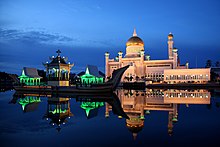
Sultan Omar Ali Saifuddin Mosque in Brunei, an Islamic country with strict Syariah rule.
Religions and peoples are diverse in Southeast Asia and not one country is homogeneous. In the world's most populous Muslim nation, Indonesia, Hinduism is dominant on islands such as Bali. Christianity also predominates in the rest of the part of the Philippines, New Guinea and Timor. Pockets of Hindu population can also be found around Southeast Asia in Singapore, Malaysia etc. Garuda (Sanskrit: Garuḍa), the phoenix who is the mount (vahanam) of Vishnu, is a national symbol in both Thailand and Indonesia; in the Philippines, gold images of Garuda have been found on Palawan; gold images of other Hindu gods and goddesses have also been found on Mindanao. Balinese Hinduism is somewhat different from Hinduism practised elsewhere, as Animism and local culture is incorporated into it. Christians can also be found throughout Southeast Asia; they are in the majority in East Timor and the Philippines, Asia's largest Christian nation. In addition, there are also older tribal religious practices in remote areas of Sarawak in East Malaysia,Highland Philippines and Papua in eastern Indonesia. In Burma, Sakka (Indra) is revered as a nat. In Vietnam, Mahayana Buddhism is practised, which is influenced by native animism but with strong emphasis on Ancestor Worship.
Cities
- Jabodetabek (Jakarta/West Java/Banten), Indonesia. Jabodetabek is an abbreviation of Jakarta, Bogor, Depok, Tangerang, and Bekasi, which are the satellite cities of the Special Capital Region of Jakarta.
- Metro Manila (Manila/Quezon City/Makati/Taguig/Pasay and 12 others), Philippines
- Bangkok Metropolitan Region (Bangkok/Nonthaburi/Samut Prakan/Pathum Thani/Samut Sakhon/Nakhon Pathom), Thailand
- Greater Kuala Lumpur/Klang Valley (Kuala Lumpur/Selangor), Malaysia
- Ho Chi Minh City Metropolitan Area (Ho Chi Minh City/Vung Tau), Vietnam
- Yangon Region (Yangon/Thanlyin), Myanmar
- Hanoi Capital Region (Hanoi/Hai Phong/Ha Long), Vietnam
- Gerbangkertosusila (Surabaya/Sidoarjo/Gresik/Mojokerto/Lamongan/Bangkalan), Indonesia
- Bandung Metropolitan Area (Bandung/Cimahi), Indonesia
- Metro Cebu (Cebu City/Mandaue/Lapu-Lapu City/Talisay City and 11 others), Philippines
- Metro Davao (Davao City/Digos/Tagum/Island Garden City of Samal), Philippines
Culture
The culture in Southeast Asia is very diverse: on mainland Southeast Asia, the culture is a mix of Indochinese (Burma, Cambodia, Laos and Thailand) and Chinese (Singapore and Vietnam). While in Indonesia, the Philippines and Malaysia the culture is a mix of indigenous Austronesian, Indian, Islamic, Western, and Chinese cultures. Also Brunei shows a strong influence from Arabia. Singapore and Vietnam show more Chinese influence[58] in that Singapore, although being geographically a Southeast Asian nation, is home to a large Chinese majority and Vietnam was in China's sphere of influence for much of its history. Indian influence in Singapore is only evident through the Tamil migrants,[59] which influenced, to some extent, the cuisine of Singapore. Throughout Vietnam's history, it has had no direct influence from India - only through contact with the Thai, Khmer and Cham peoples.
Rice paddy agriculture has existed in Southeast Asia for thousands of years, ranging across the subregion. Some dramatic examples of these rice paddies populate the Banaue Rice Terraces in the mountains of Luzon in the Philippines. Maintenance of these paddies is very labour-intensive. The rice paddies are well-suited to the monsoon climate of the region.
Stilt houses can be found all over Southeast Asia, from Thailand and Laos, to Borneo, to Luzon in the Philippines, to Papua New Guinea. The region has diverse metalworking, especially in Indonesia. This include weaponry, such as the distinctive kris, and musical instruments, such as the gamelan.
Influences
The region's chief cultural influences have been from some combination of Islam, India, and China. Diverse cultural influence is pronounced in the Philippines, derived particularly from the period of the Spanish and American rule, contact with Indian-influenced cultures, and the Chinese trading era. The Filipinos are of indigenous Austronesian blood with varying admixtures of Indian, Arab, Spanish, and Chinese.
As a rule, the peoples who ate with their fingers were more likely influenced by the culture of India, for example, than the culture of China, where the peoples ate with chopsticks; tea, as a beverage, can be found across the region. The fish sauces distinctive to the region tend to vary.
Arts
The arts of Southeast Asia have affinity with the arts of other areas. Dance in much of Southeast Asia includes movement of the hands as well as the feet, to express the dance's emotion and meaning of the story that the ballerina is going to tell the audience. Most of Southeast Asia introduced dance into their court; in particular, Cambodian royal ballet represented them in the early 7th century before the Khmer Empire, which was highly influenced by Indian Hinduism. Apsara Dance, famous for strong hand and feet movement, is a great example of Hindu symbolic dance.
Puppetry and shadow plays were also a favoured form of entertainment in past centuries, a famous one being Wayang from Indonesia. The arts and literature in some of Southeast Asia is quite influenced by Hinduism, which was brought to them centuries ago. Indonesia, despite conversion to Islam which opposes certain forms of art, has retained many forms of Hindu-influenced practices, culture, art and literature. An example is the Wayang Kulit (Shadow Puppet) and literature like the Ramayana. The wayang kulit show has been recognized by UNESCO on November 7, 2003, as a Masterpiece of Oral and Intangible Heritage of Humanity.
It has been pointed out that Khmer and Indonesian classical arts were concerned with depicting the life of the gods, but to the Southeast Asian mind the life of the gods was the life of the peoples themselves—joyous, earthy, yet divine. The Tai, coming late into Southeast Asia, brought with them some Chinese artistic traditions, but they soon shed them in favour of the Khmer and Mon traditions, and the only indications of their earlier contact with Chinese arts were in the style of their temples, especially the tapering roof, and in their lacquerware.
Music
Traditional music in Southeast Asia is as varied as its many ethnic and cultural divisions. Main styles of traditional music can be seen: Court music, folk music, music styles of smaller ethnic groups, and music influenced by genres outside the geographic region.
Of the court and folk genres, gong-chime ensembles and orchestras make up the majority (the exception being lowland areas of Vietnam). Gamelan and Angklung orchestras from Indonesia, Piphat /Pinpeat ensembles of Thailand and Cambodia and the Kulintang ensembles of the southern Philippines, Borneo, Sulawesi and Timor are the three main distinct styles of musical genres that have influenced other traditional musical styles in the region. String instruments also are popular in the region.
On November 18, 2010, UNESCO officially recognized angklung as a Masterpiece of Oral and Intangible Heritage of Humanity, and encourage Indonesian people and government to safeguard, transmit, promote performances and to encourage the craftsmanship of angklung making.
Writing
The history of Southeast Asia has led to a wealth of different authors, from both within and without writing about the region.
Originally, Indians were the ones who taught the native inhabitants about writing. This is shown through Brahmic forms of writing present in the region such as the Balinese script shown on split palm leaf called lontar (see image to the left — magnify the image to see the writing on the flat side, and the decoration on the reverse side).
The first document found in the Philippines, the Laguna Copperplate Inscription
The antiquity of this form of writing extends before the invention of paper around the year 100 in China. Note each palm leaf section was only several lines, written longitudinally across the leaf, and bound by twine to the other sections. The outer portion was decorated. The alphabets of Southeast Asia tended to be abugidas, until the arrival of the Europeans, who used words that also ended in consonants, not just vowels. Other forms of official documents, which did not use paper, included Javanese copperplate scrolls. This material would have been more durable than paper in the tropical climate of Southeast Asia.
In Malaysia, Brunei, and Singapore, the Malay language is now generally written in the Latin script. The same phenomenon is present in Indonesian, although different spelling standards are utilised (e.g. 'Teksi' in Malay and 'Taksi' in Indonesian for the word 'Taxi').
The use of Chinese characters, in the past and present, is only evident in Vietnam and more recently, Singapore and Malaysia. The adoption of Chinese characters in Vietnam dates back to around 111BC, when it was occupied by the Chinese. A Vietnamese script called Chu nom used modified Chinese characters to express the Vietnamese language. Both classical Chinese and Chu Nom were used up until the early 20th century.
 Freebies, coupons, trials, reduced items & smart shopping can all reduce your food bills here are a few tips:
 Price glitch at Tesco’s, giving 1p Lindor chocolate & Cadbury mini eggs.
 105 free bottles of beer delivered to your house. Offer now finished. Original post.
 Have you ever lost a phone? Had a computer stolen? Or just had something stop working that you really needed
 It sounds strange that buying something can save or even make you money but it’s 100% true.
 Enter as many competitions as possible – remember somebody has to win.
 We’ve been doing this for the past few years and we’ve significantly saved so much money.
 Many online bookmakers offer a signup bonus usually a free bet, as an incentive to try and entice you to opening an account with them. This usually requires an initial bet with your own money to obtain the free bet, by using a betting exchange such as Betfair you can remove the risk of losing your own money and extract the free bet in the process to make a profit.
 Get all your stuff out and have a well deserved sort, you need to start off by sorting into 5 piles: